
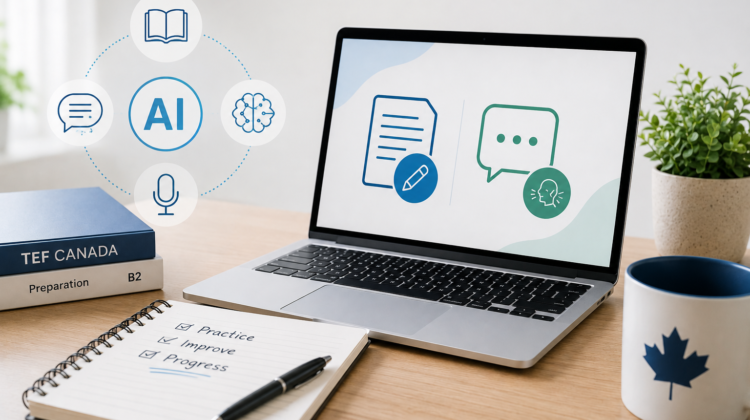
How to Use AI to Prepare for TEF Written and Oral Expression
Are you preparing for the TEF Canada exam and looking for more ways to improve your written and oral expression?
Artificial intelligence can be a useful practice tool. It can help you correct written work, simulate conversations and identify common language mistakes.
However, AI should be used as a complement to your French classes, not as a replacement for a qualified teacher.
Can AI Help With TEF Canada Preparation?
Yes, especially for regular practice.
AI can help you:
- Correct grammar and spelling
- Improve vocabulary
- Rewrite unclear sentences
- Practise common speaking situations
- Identify repeated mistakes
- Create exercises based on your weaknesses
The quality of the feedback depends heavily on the instructions you provide. AI may also make mistakes, so important corrections should always be verified.
Using AI for TEF Written Expression
For the TEF written expression section, you can write a response and ask an AI tool to review it.
Make sure you include:
- The exercise instructions
- Your full answer
- The type of feedback you want
- Your target level, such as B2
Prompt for Correcting Your Writing
You can use the following prompt:
I am preparing for the TEF written expression test.
Here are the instructions:
[Insert the exercise instructions]
Here is my response:
[Insert your text]
Please identify my grammar, spelling, vocabulary and sentence-structure mistakes. Explain each mistake and suggest a corrected version. Do not completely rewrite the text.
This type of prompt is useful because it asks the AI to explain the mistakes instead of simply replacing your answer.
Prompt for Targeted Practice
After receiving the corrections, you can continue with:
Based on the mistakes in my text, create five short exercises to help me improve my grammar, vocabulary and sentence structure.
This allows you to turn one written exercise into a more complete TEF preparation activity.
Ask for CEFR-Based Feedback
For more relevant feedback, ask the AI to evaluate your response using the Common European Framework of Reference for Languages (CEFR).
For example:
Please evaluate this response according to CEFR B2 criteria. Comment on vocabulary, grammar, organization, clarity and ability to develop ideas.
This can help you understand whether your writing is simple, clear and well developed.
However, an AI estimate is not an official TEF score.
Using AI for TEF Oral Expression
AI voice tools can also help with TEF oral expression preparation.
You can practise situations such as:
- Asking for information
- Speaking with a friend
- Explaining a problem
- Giving an opinion
- Convincing someone
- Discussing the advantages and disadvantages of an idea
Prompt for Oral Practice
Try this prompt:
Act as a French teacher helping me prepare for the TEF oral expression test. Ask me one question at a time at the B2 level. After each answer, briefly correct my grammar, vocabulary and sentence structure, and then continue the conversation.
You can also ask the AI to simulate a specific TEF task:
Simulate a TEF oral expression activity where I must ask questions to obtain information. Do not give me all the information immediately. Answer only the questions I ask.
This is especially useful for practising natural interaction and learning how to ask follow-up questions.
Practising Persuasion and Opinions
For opinion-based tasks, use a prompt such as:
Give me a topic suitable for TEF oral expression. Ask me to convince a friend to accept an idea. Challenge my arguments and ask follow-up questions.
This helps you practise:
- Presenting an idea clearly
- Giving reasons and examples
- Responding to objections
- Using persuasive vocabulary
- Speaking for a longer period without stopping
Ask for Feedback After Speaking
After the conversation, ask the AI:
Based on my answers, list my main grammar, vocabulary and pronunciation weaknesses. Then give me three exercises to improve them.
This creates a clear study plan based on your actual performance.
Limits of AI for TEF Preparation
AI can be helpful, but it has limits.
It may:
- Misunderstand your pronunciation or accent
- Suggest unnatural expressions
- Overlook the exact requirements of the task
- Give feedback that is too general
- Estimate your level incorrectly
It also cannot fully evaluate communication skills, confidence, interaction and the overall quality of your performance in the same way as an experienced French teacher.
AI Should Support Your French Lessons
The best approach is to combine different methods:
- Practise regularly with AI
- Work with a French teacher
- Complete timed TEF exercises
- Review official test formats
- Speak French as often as possible
- Keep a list of your most common mistakes
AI is especially useful between classes because it allows you to practise whenever you have time.
Final Advice
Using AI for TEF Canada preparation can help you write more accurately, speak more confidently and practise more often.
The key is to give clear instructions and use AI feedback carefully.
For the best results, combine AI practice with professional teaching, realistic TEF exercises and regular speaking practice.