
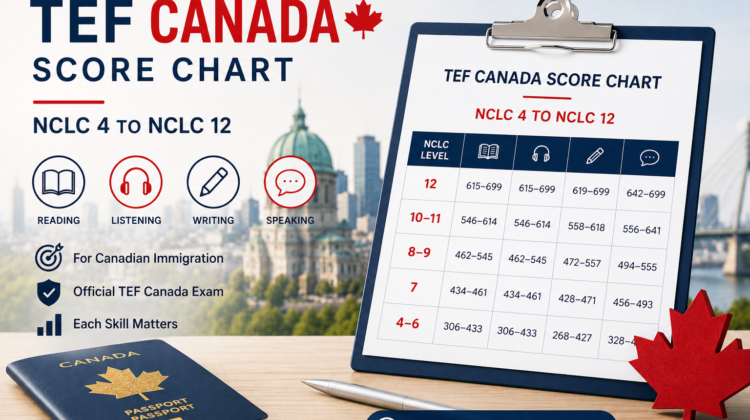
TEF Canada Score Chart: NCLC 4 to NCLC 12
Looking for the latest TEF Canada score chart? See how TEF Canada scores from 0 to 699 correspond to NCLC levels 4 to 12 for reading, listening, writing, and speaking.
If you are taking the TEF Canada for Canadian immigration, one of the most important things to understand is how your TEF score converts to an NCLC level.
IRCC uses the NCLC (Niveaux de compétence linguistique canadiens) system to evaluate French-language ability for immigration programs, including Express Entry.
Since December 11, 2023, TEF Canada results have been reported using the current 0–699 scoring system. Each language ability receives its own score and NCLC level.
That means your reading, listening, writing, and speaking results may correspond to different NCLC levels.
TEF Canada Score Chart: NCLC 4 to NCLC 12
The following table shows the current TEF Canada score ranges for tests taken from December 11, 2023 onward.
| NCLC Level | Reading | Listening | Writing | Speaking |
|---|---|---|---|---|
| NCLC 12 | 615–699 | 615–699 | 619–699 | 642–699 |
| NCLC 11 | 573–614 | 573–614 | 577–618 | 592–641 |
| NCLC 10 | 546–572 | 546–572 | 558–576 | 556–591 |
| NCLC 9 | 503–545 | 503–545 | 512–557 | 518–555 |
| NCLC 8 | 462–502 | 462–502 | 472–511 | 494–517 |
| NCLC 7 | 434–461 | 434–461 | 428–471 | 456–493 |
| NCLC 6 | 393–433 | 393–433 | 379–427 | 422–455 |
| NCLC 5 | 352–392 | 352–392 | 330–378 | 387–421 |
| NCLC 4 | 306–351 | 306–351 | 268–329 | 328–386 |
Source: CCI Paris Île-de-France, TEF Canada score-to-NCLC correspondence table effective December 11, 2023.
Important: Your TEF Canada score is interpreted separately for each language ability. The score range for one ability may be different from the range for another ability.
For immigration purposes, always verify the current requirements of your specific program on the official Government of Canada website.
What TEF Score Is NCLC 7?
NCLC 7 is one of the most common targets for Canadian immigration, particularly for candidates interested in the French-language proficiency category under Express Entry.
To reach NCLC 7, the minimum current TEF Canada scores are:
- Reading: 434
- Listening: 434
- Writing: 428
- Speaking: 456
Each section is evaluated separately.
For example, a score of 440 is within the NCLC 7 range for reading and listening. However, a score of 440 in speaking is below the NCLC 7 threshold of 456.
This is why you should not think of your TEF Canada result as one overall score.
You need to check your result for each of the four abilities.
What TEF Score Is NCLC 9?
For NCLC 9, the minimum current TEF Canada scores are:
- Reading: 503
- Listening: 503
- Writing: 512
- Speaking: 518
NCLC 9 can be valuable for Express Entry candidates because higher French-language results can contribute to a stronger CRS profile.
However, the exact benefit depends on your complete Express Entry profile and the rules in effect when you apply.
What Is the Highest NCLC Level on the TEF Canada Score Chart?
The TEF Canada scoring table extends to NCLC 12.
The current 0–699 scale distinguishes between NCLC 10, NCLC 11, and NCLC 12:
- NCLC 10: Reading and Listening 546–572
- NCLC 11: Reading and Listening 573–614
- NCLC 12: Reading and Listening 615–699
The thresholds are different for writing and speaking.
For example, NCLC 12 begins at 619 in writing and 642 in speaking.
Some IRCC immigration tables group results at NCLC 10 and above rather than displaying NCLC 11 and NCLC 12 separately. This does not mean that the TEF Canada score chart itself stops at NCLC 10.
Is NCLC 7 the Same as B2?
Not exactly.
B2 is a level within the Common European Framework of Reference for Languages (CEFR), while NCLC is the Canadian language benchmark system used for French-language assessment in Canadian immigration.
The two systems are related, but they are not interchangeable.
For Canadian immigration purposes, use the NCLC level and TEF Canada conversion required by IRCC rather than relying only on the CEFR level shown on your TEF certificate.
Do I Need NCLC 7 in All Four Sections?
For the French-language proficiency category under Express Entry, candidates must have French test results showing at least NCLC 7 in all four language abilities.
That means you need to meet the minimum level in:
- Reading
- Writing
- Listening
- Speaking
A high score in one section cannot compensate for a section that is below the required level.
For other Express Entry programs, the minimum language requirement may be different. For example, the Federal Skilled Worker Program requires NCLC 7 as the minimum level in all four abilities for French as the first official language, while the Canadian Experience Class and Federal Skilled Trades Program have different requirements depending on the program and occupation.
Always check the requirements of the specific immigration program you are applying under.
What TEF Score Do I Need for Express Entry?
There is no single TEF Canada score required for every Express Entry applicant.
Your required level depends on:
- The Express Entry program you qualify under
- Whether French is your first or second official language
- Whether you are targeting the French-language proficiency category
- Your English-language results
- Your overall CRS profile
For the French-language proficiency category, the current requirement is NCLC 7 or higher in all four French abilities, in addition to meeting the other eligibility requirements for an Express Entry program.
Candidates with NCLC 7 or higher in all four French abilities may also receive additional CRS points for French-language skills. Depending on their English results, the additional points can be up to 50.
Why Does My TEF Certificate Show Different Score Equivalencies?
You may see more than one type of score or equivalency on your TEF Canada statement of results.
This can be confusing because the TEF scoring system and its presentation have changed over time.
For tests taken from December 11, 2023 onward, the current TEF Canada score chart uses the 0–699 scale shown above. Older TEF Canada tests use different score ranges.
There is also an important distinction between the “Score / 699” shown on the TEF Canada attestation and the score information that IRCC currently asks candidates to enter in an Express Entry profile.
IRCC states that Express Entry candidates should use the “Équivalence ancien score” column when entering TEF Canada results. The scores shown in the “Score / 699” column should not be entered directly into the Express Entry profile because they are not compatible with the system at this time.
If you are unsure which score to enter, check the latest IRCC instructions before submitting your profile.
Why Is My TEF Canada Score Different From an Older Chart?
If you find a different TEF Canada score chart online, check the date of the test before assuming that one of the charts is wrong.
The current score conversion applies to tests taken after December 10, 2023.
For tests taken between October 1, 2019 and December 10, 2023, a different conversion table applies.
This is one reason why old screenshots, calculators, and blog posts can produce different results.
Always use a score table that matches your test date.
How to Use the TEF Canada Score Chart
The score chart is most useful when you use it to set a specific target for each ability.
1. Identify your required NCLC level
First determine the NCLC level required for your immigration program.
Do not assume that NCLC 7 is automatically the requirement for every immigration pathway.
2. Check all four abilities
Write down the minimum score required for:
- Reading
- Listening
- Writing
- Speaking
This helps you identify which skill needs the most attention.
3. Track your practice scores separately
Do not rely only on an average practice score.
For example, strong reading and listening results may hide a weaker writing or speaking performance.
Track each skill independently.
4. Aim above the minimum
If your target is NCLC 7, do not plan your preparation around barely reaching the minimum.
Practice results can vary from one test to another. Building a reasonable margin can reduce the risk of falling below your target on test day.
5. Check the official requirements before applying
Immigration requirements can change.
Before using your TEF Canada results for an application, verify the current requirements on the Government of Canada website.
Frequently Asked Questions
What is the minimum TEF Canada score for NCLC 7?
The minimum scores for NCLC 7 are:
- Reading: 434
- Listening: 434
- Writing: 428
- Speaking: 456
All four abilities have their own threshold.
What is the minimum TEF Canada score for NCLC 9?
The minimum scores for NCLC 9 are:
- Reading: 503
- Listening: 503
- Writing: 512
- Speaking: 518
Can I average my four TEF Canada scores?
No.
Your four abilities are assessed separately. A high result in one ability does not automatically compensate for a lower result in another ability.
Can I use my TEF Canada 0–699 score directly in Express Entry?
Not necessarily.
IRCC currently instructs Express Entry candidates to use the “Équivalence ancien score” values from their TEF Canada results rather than entering the “Score / 699” values directly.
How long are TEF Canada results valid?
TEF Canada results are generally valid for two years.
If you are using your results for Express Entry, check that your language test remains valid at the relevant stages of your application.
Final Tip
Do not focus only on your overall French level.
For Canadian immigration, your individual TEF Canada scores matter because each language ability is evaluated separately.
If your goal is NCLC 7, NCLC 9, or a higher level, identify the minimum score required for reading, listening, writing, and speaking before booking your exam.
Use the current score chart, check your test date, and verify the immigration requirements that apply to your specific situation.
Take Your TEF Canada Exam in Montréal
CSA Montréal offers official TEF Canada and TEFAQ exams in downtown Montréal.
Candidates can check upcoming exam dates, available sessions, and registration information directly through our website.
Ready to book your TEF Canada exam?