
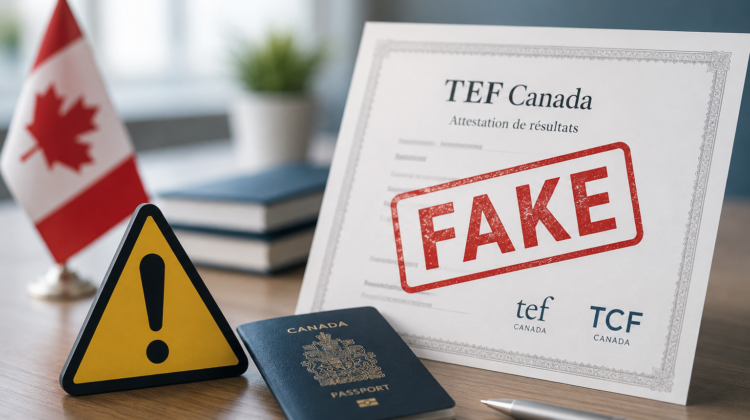
Beware of Fake TEF and TCF Certificates: Avoid These Costly Mistakes
For many candidates, a French language test for Canadian immigration is more than just an exam.
A valid TEF Canada or TCF Canada result can be an important step toward:
- Express Entry,
- permanent residence,
- Quebec immigration,
- Canadian citizenship,
- or professional opportunities in Canada.
Because of this pressure, some candidates become vulnerable to shortcuts and online scams.
You may have seen advertisements promising:
- “Guaranteed CLB 7”
- “Guaranteed NCLC 7”
- “Real TEF Canada certificate”
- “TCF Canada result without taking the exam”
These offers are extremely dangerous.
A fake TEF or TCF certificate can seriously damage:
- your immigration application,
- your future opportunities,
- and your credibility with Canadian authorities.
What Is a Fake TEF or TCF Certificate?
A fake certificate may include:
- a completely false TEF Canada or TCF Canada certificate,
- a modified PDF score report,
- a realistic-looking fake document created online,
- a certificate issued under another person’s identity,
- a result obtained through cheating or impersonation,
- or a so-called “inside connection” promising a score without taking the exam.
Some fraudsters even claim they can:
- “register your result in the system,”
- “guarantee CLB 7,”
- or “help you pass without attending the test.”
These are major warning signs.
No legitimate TEF or TCF test centre can sell scores or guarantee language levels.
Your result must reflect your real performance on exam day.
Why Fake Language Results Are Extremely Risky
Submitting a fake French language certificate to:
- IRCC,
- MIFI,
- or any Canadian authority
may be treated as misrepresentation or fraud.
Possible Consequences
The consequences can include:
- refusal of your immigration application,
- loss of credibility in future applications,
- inadmissibility to Canada,
- cancellation of your language results,
- legal consequences,
- or temporary bans from official exams.
Even if another person created the fake document for you, you may still be responsible for what is submitted under your name.
A fake certificate is not a shortcut.
It can become a long-term immigration problem.
What Official TEF and TCF Organizations Say About Fraud
Official French testing organizations take fraud very seriously.
Examples of Fraud
Fraud may include:
- identity substitution,
- impersonation,
- fake documents,
- altered score reports,
- cheating during the exam,
- using unauthorized devices,
- or attempting to obtain results dishonestly.
Whether it is TEF Canada or TCF Canada, all candidates must follow official exam rules and procedures.
What Candidates Should Never Do
Candidates should never:
- buy a TEF Canada or TCF Canada certificate online,
- ask someone else to take the exam for them,
- edit or modify a score report,
- submit a certificate obtained outside the official process,
- trust “guaranteed CLB 7” offers,
- use hidden devices or unauthorized materials during the exam,
- buy or share real exam questions,
- or ask staff members or agents to “arrange” a result.
Even contacting suspicious services can expose you to:
- scams,
- identity theft,
- or immigration risks.
Be Careful With “Real TEF/TCF Questions”
Some websites and social media accounts claim to sell:
- “real TEF Canada questions,”
- “exact TCF exam topics,”
- or “recent exam answers.”
Candidates should be cautious.
Official exam content is confidential.
Sharing or using leaked exam materials may violate exam rules and could lead to penalties.
The Right Way to Prepare for TEF Canada or TCF Canada
Proper preparation means:
- understanding the exam format,
- practising speaking and writing tasks,
- improving vocabulary,
- developing listening skills,
- and building real French ability.
Good preparation is based on learning — not shortcuts.
How to Protect Yourself
To stay safe, candidates should:
- register only through authorized TEF or TCF test centres,
- use the exact name shown on their passport or ID,
- keep official emails and receipts,
- prepare using legitimate study materials,
- avoid suspicious agents,
- never share sensitive documents carelessly,
- and contact the official test centre directly if unsure.
If something sounds:
- too easy,
- too fast,
- or too guaranteed,
it is probably not legitimate.
A Real Score Is Always Better Than a Fake Shortcut
French exams can be stressful, especially for immigration candidates who need:
- CLB 7,
- NCLC 7,
- B2,
- or higher scores.
But fake certificates are not solutions.
A lower real score can always be improved through practice and a future retake.
A fake result can damage your entire immigration process.
The safest path is always:
- register properly,
- prepare seriously,
- follow exam rules,
- and earn your result honestly.
Final Reminder
TEF Canada and TCF Canada are official French language tests accepted for Canadian immigration.
Only authentic results obtained through the proper exam process are valid.
Candidates should never:
- buy,
- modify,
- borrow,
- or submit fake language certificates.
Your French test result should support your future — not put it at risk.